Staff Scheduling: 7 Problems and How to Fix Them
July 23, 2026

I have seen many pet businesses lose time, money, and team trust because of weak staff scheduling. It often starts small. One missed shift. One double booking. One groomer who feels overloaded while another has a slow afternoon. Then the week gets messy.
In my experience, a good plan for employee scheduling is not just about filling slots on a calendar. It is about matching people, skills, pet volume, and customer demand in a way that keeps the day calm. This matters even more in grooming salons, boarding sites, and daycare operations, where every late handoff can affect pets, clients, and staff.
A strong schedule gives a pet business more control, fewer errors, and a better customer experience.
I think this is one reason platforms like Buddyz are getting attention. Instead of treating shifts, pet records, payments, and staffing as separate tasks, it connects them. That helps owners see the whole day, not just blocks of time.
Problem 1: Scheduling without demand forecasting
One of the most common issues I saw was guessing. Some managers build next week’s rota based on habit, not data. That leads to too many people on quiet days and not enough coverage when appointments rise.
Demand forecasting means using past patterns, bookings, seasonality, and service mix to predict staffing needs.
For a grooming shop, this can be simple at first:
- Review how many baths, full grooms, nail trims, and add-ons you handled by day.
- Track busy periods such as weekends, holidays, and weather shifts.
- Note breed mix, since large dogs take more time than small dogs.
- Compare no-show rates and late arrivals by day and hour.
I once worked with a salon that scheduled the same number of groomers every Tuesday because “Tuesday is always steady.” It was not. Their booking data showed that the first Tuesday after payday was packed, while the third Tuesday was usually light. That one insight changed labor planning.
A simple example helps. If your average Saturday includes 18 grooming appointments, 6 express services, and 12 daycare check-ins before 10 a.m., your staffing plan should reflect that flow. You may need:
- 3 groomers from 8 a.m. to 4 p.m.
- 1 bather from 7:30 a.m. to 3:30 p.m.
- 1 front desk team member for check-in and calls
- 1 flex staff member from 9 a.m. to 1 p.m.
With Buddyz, I can see how a pet business would connect booking trends with staffing needs more clearly than with a basic calendar app. Some other tools can handle shifts, but they often feel generic. Pet businesses need service-based planning, not just a timetable.
Problem 2: Poor shift planning
Many teams do not struggle because they lack workers. They struggle because the shift structure is weak. Start times do not match check-in flow. Lunch breaks stack up at the same hour. Closing tasks get ignored.
Bad shift planning creates avoidable chaos.
When I build a grooming staff schedule, I like to map the day in stages, not just hours:
- Opening setup and pet intake
- Peak grooming production time
- Midday calls, add-ons, and walk-ins
- Pickup rush and cleanup
The best shift plan follows the work itself, not a fixed idea of what a workday should look like.
Here is a basic example for a weekday salon:
- 7:30 a.m. to 3:30 p.m. for opening support and early pets
- 8 a.m. to 4 p.m. for core grooming staff
- 10 a.m. to 6 p.m. for pickups, call volume, and late appointments
- 12 p.m. to 4 p.m. for part-time bathing or kennel help
This kind of staggered setup helps with shift management because the team is not all arriving or leaving at once. I have seen this reduce delays almost immediately.
If you want more ideas on process planning, I suggest reviewing related operational content such as service workflow examples and broader staffing perspectives from Marcus.
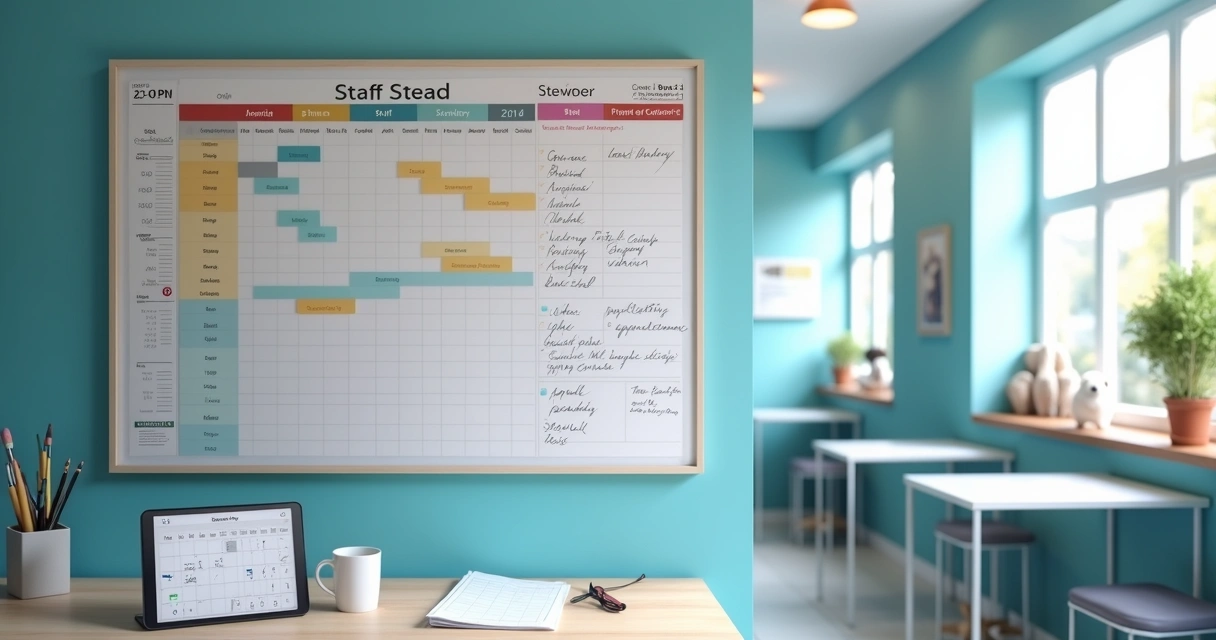 Problem 3: Time-off requests handled too late
I have seen managers approve vacation or personal leave in scattered messages, then realize too late that three people are out on the same weekend. This is a classic source of conflict.
Time-off management works best when requests follow clear rules, deadlines, and visibility for the whole team.
My preferred approach includes a few simple rules:
- Set a request deadline, such as two weeks ahead for normal leave.
- Limit how many people in the same role can be off at once.
- Approve requests in one place, not across texts and calls.
- Track blackout dates around known busy periods.
A grooming salon with four groomers usually cannot approve two full-day absences on a Saturday in December. That is not unfair. That is planning.
I also think fairness matters. Rotating high-demand leave periods, such as holiday weekends, reduces resentment. Staff can accept “not this time” more easily when the process is visible and consistent.
Some businesses try to solve this with basic scheduling software made for any industry. In my view, that often leaves too much manual work. Buddyz stands out because pet businesses also need to see appointments, staffing, and customer promises together before approving time away.
Problem 4: Workload is not balanced
This problem is easy to miss because everyone may look busy. But busy is not the same as balanced. One groomer may get all large doodles and matted coats, while another handles quick baths and easy trims. On paper, both have six pets. In reality, one person has a much harder day.
Workload balancing means assigning work by time, skill, pet type, and physical strain, not just by appointment count.
I like to review these factors when assigning the day:
- Pet size and coat condition
- Service length
- Employee skill and speed
- Need for team lifting or extra handling
I remember one salon where a top groomer was always “trusted” with the toughest dogs. She was skilled, yes, but she was also exhausted. Within months, she was thinking about leaving. Better shift management would have protected both her and the business.
For recurring schedules, I suggest using a base weekly pattern, then adjusting the hardest appointments around it. That keeps routine while avoiding overload. If Monday is usually full of large-breed appointments, rotate those cases instead of assigning them to the same person each week.
You can find more business planning content in resources like day-to-day scheduling ideas and topic-based searches through the Buddyz content library.
Problem 5: Too much overtime
Overtime often starts as a small patch. A late pickup here. An extra appointment there. A staff shortage on Friday. Then payroll grows, and the team gets tired.
Overtime is often a planning problem before it becomes a payroll problem.
In my experience, overtime reduction comes from better structure, not pressure. Telling staff to “work faster” is not a fix. Better actions include:
- Stop accepting services that cannot be completed within staffed hours.
- Build short buffer gaps between complex appointments.
- Use split or staggered shifts on heavy days.
- Watch closing tasks as part of the labor plan.
A simple example: if your last full groom starts at 4 p.m. but your groomer ends at 5 p.m., you are not planning a one-hour service. You are planning overtime.
I think pet businesses need software that shows this risk before the week begins. Buddyz makes sense here because scheduling is tied to the actual operation, including services and staff availability. That is far more useful than tools that only move names across a grid.
 Problem 6: Recurring schedules become rigid
I like recurring schedules because they reduce admin work and give staff a stable routine. But I have also seen them become too rigid. The same hours repeat even when demand changes, new services are added, or one person grows into a new role.
Recurring schedules should be a starting point, not a rule that ignores real business changes.
My advice is to keep a repeating base, then review it every month. Ask:
- Are peak hours still the same?
- Has one team member taken on more advanced grooming work?
- Are weekends carrying too much pressure?
- Did seasonal boarding affect the salon side?
I once saw a pet daycare and grooming business stick to a winter staffing pattern into late spring. They kept overstaffing mornings and understaffing evenings, even though customer pickups had shifted. A quick monthly review would have fixed it.
This is where an operating system built for pet businesses helps. Buddyz is not just a roster tool. It lets owners connect recurring shift plans to the wider flow of pets, services, payments, and team tasks.
Problem 7: No clear system for conflicts and last-minute changes
No matter how careful the schedule is, changes happen. Someone calls in sick. A pet arrives late and affects the next slot. A staff member says they thought they started at noon, not 11. Without one clear process, confusion spreads fast.
Scheduling conflicts get solved faster when everyone uses one source of truth.
I recommend a simple conflict process:
- Record the issue in one system right away.
- Check who is available and qualified to cover.
- Update the shift in real time.
- Notify only the people affected.
This avoids long text threads and missed updates. It also helps with accountability. If a shift change is visible, there is less room for confusion.
I have looked at other scheduling tools that promise fast changes, but many are built for broad service sectors. Pet businesses need more context. If a groomer is out, you need to know which pets were assigned, which services can be moved, and what customers must be told. That is where Buddyz has the edge.
What I would do to build a better schedule
If I were setting up staff planning for a pet business from scratch, I would keep it practical. Not fancy. Just reliable.
- Start with booking history and demand by day and hour.
- Create staggered shifts around real service flow.
- Set clear time-off rules and deadlines.
- Balance work by service load, not just headcount.
- Review overtime weekly and trace its cause.
- Use recurring patterns, but revisit them often.
- Keep every change in one system.
That is how employee scheduling becomes more stable. Not perfect, but stable. And stable teams can serve more pets with less stress.
If your current process still depends on memory, text messages, and spreadsheets, I think it is time to change it. Buddyz was built for pet businesses that want better control of schedules, staff, appointments, and daily operations in one place. If that sounds like the next step for your team, get to know Buddyz and see how it can support your business.
Frequently asked questions
What is employee scheduling software?
Employee scheduling software is a tool that helps businesses plan work hours, assign shifts, track availability, manage time-off, and update rota changes in one place. In my view, the best versions also connect scheduling with appointments, staffing levels, and daily operations. That is why a pet-focused platform such as Buddyz can be more helpful than a generic tool.
How to make a grooming staff schedule?
I would start with booking volume, service length, pet size, and peak drop-off and pickup times. Then I would assign staggered shifts, balance hard and easy appointments across the team, and leave buffer time for delays. A good grooming staff schedule also includes front desk support, cleanup time, and rules for time-off requests.
What are common shift management problems?
The most common problems I have seen are understaffing during busy periods, overstaffing on slow days, poor handling of time-off requests, uneven workload, too much overtime, rigid recurring schedules, and confusion during last-minute changes. These issues often come from weak planning systems rather than staff effort.
How can I fix scheduling conflicts?
I would fix scheduling conflicts by keeping all shift changes in one system, checking qualified backup coverage fast, and updating the team in real time. Clear policies also help. When staff know how swaps, absences, and late changes are handled, conflicts are easier to solve and less likely to repeat.
Is automated scheduling worth the cost?
In many cases, yes. I think automated scheduling is worth the cost when it reduces overtime, prevents missed coverage, saves manager time, and improves service flow. For pet businesses, the value is even higher when the platform also ties scheduling to bookings, pet records, payments, and customer communication, which is where Buddyz stands out.